
Breaking the Endless Cycle of Stupid Political Decisions
Published: 2nd October 2026
The Latest Government Nonsense
The government announced a new equity loan scheme, titled Your First Home,1 for first-time house buyers. A buyer requires a 2.5% deposit for a mortgage that will be supplemented by a 20% equity loan from the government, creating a total deposit of 22.5% so the mortgage from a bank will be 77.5% instead of 97.5%. This is merely a replication of the disastrous Help to Buy scheme from over a decade ago and it pains me that politicians are repeating exactly the same mistakes. On the surface, and to those that are blind to consequences, it sounds positive: the government assists first-time buyers to buy property. The Help to Buy scheme is examined in the tapeinocracy book and shown to cause dramatic increases in property prices because it’s merely a subsidy for property developers. This new scheme is a rebranding exercise and it will equally cause a surge in the price of housing just as the Help to Buy scheme did a decade ago.
Without the scheme, those same buyers wouldn’t be able to afford property. Banks creating money for mortgages is the bigger issue, itself enabled by the government for allowing banks to endlessly create money. Nevertheless, if a particular property is unaffordable then it remains unsold and the seller holds an unwanted depreciating physical asset that still has running costs and taxes. He is pressured to sell as time is against him so he must lower his price until someone can afford to buy his property. This is how the property bubble should be deflated to bring house prices back down to earth. But no, people are shortsighted and the government will continue to subsidise the housing market, further inflating prices and directly exacerbating the very problem it wants to ameliorate.
In summary: politicians yet again make the wrong decision by choosing to harm the whole country long-term in exchange for a short-term gain toward themselves and a portion of society. This article will explain the reason why the UK’s politicians always choose the worst option in every situation.
The Cause
Casting a glance back over time shows approximately one century of bad political decisions in the UK. It doesn’t matter which person holds the position of prime minister or which party maintains a majority in Parliament; the quality of choices made are seldom positive. Why? Conservative types will likely say it’s a result of straying from the path that worked so well in centuries prior, while socialists will probably blame capitalists or any man with more than ten roubles in his pocket. In my view, these are both wrong because they’re ideological and the reality is a natural consequence of the change to the political process around that time.
Throughout the UK’s history, politics was essentially a side hobby for landholders whom pulled mostly in the same direction to facilitate their interests. The public’s voting rights were restricted to male landholders, ensuring a stagnant system that suited landholders and never changed. Anything promoting mercantilism and protectionism would be good, while anything that interfered with the comfortable status quo was squashed; politics was a private club for a certain type of fellow. In the early twentieth century, several major changes occurred that drastically impacted the country’s political system:
- Politicians were paid a hefty salary
- Voting rights were expanded from landholding men to all adults
Firstly, the role of a politician changed from being voluntary into a salaried job in 1911,2 removing a major hurdle for anyone entering politics that wasn’t already self-financed, such as landholders, or those patronised in the case of trade union representatives. Secondly, suffrage increased in 1928 so that every adult over the age of 21 could vote3 thus politicians had a much wider pool of people to appease instead of merely other landholders.
How is any of this significant? The demography of politicians shifted away from landed gentry and more towards average people, meaning that politicians would no longer operate solely in the best interests of landholders; plus the introduction of a salary turned politicians from wealthy volunteers using their life experience into empty professional speakers on someone else’s behalf. In the final Commons debate on this topic, Colonel Arthur Lee as the MP for Fareham said: “I think we have a notorious example before us of what happens— and I only speak of countries with which I am thoroughly familiar—in the United States of America and Canada. There we know that representative and influential men, speaking generally, have the greatest reluctance to enter politics at all. As a matter of fact, with very few exceptions they do not enter politics. How often have I myself, when I raised that very point with men of that description in Canada and in the United States, heard them reply, "Why should we? We pay others to do that for us." … I find in the United States of America, where the salaries of Members of Parliament are higher than in any other country in the world, there is not a single genuine working man in the Congress.”4
Over the last century, politicians are now overwhelmingly made up of career professionals that entered the political system immediately out of school, whether that’s people joining trade unions as agitators, gaining an internship at a think-tank, or working as an assistant for an MP with hopes to replace him a decade later. It would seem Lee’s concerns were well-founded and the existence of a high salary makes politicians more determined to do whatever it takes to hold their seats, creating a lamentable link with the next point.
Expanded voting rights meant that politicians would have to appease ordinary people from all walks of life, not just fellow landholders, consequently finding themselves pulled in many directions rather than one. Combine this with a deeply flawed first preference plurality voting model and the outcome is a political system in which politicians must make decisions that try to satisfy as many people as possible in order to gain or keep their seats in Parliament. If a politician wants to maintain a long career and continue to absorb a fat salary then he must appease the mob and this is the fundamental reason why the majority of political decisions over the last century were absolute bilge.
Dangerous Patterns
If political decisions are made on the sole basis of pleasing as many people as possible then it leads to a series of stupid choices and an unbreakable cycle of woeful incompetence. As demonstrated in the book, Tapeinocracy: Building a Better Society, politicians are the underlying source of the overwhelming majority of problems in the UK by directly causing and failing to fix them. Why? It’s very simple: in order to maximise the number of votes, politicians will forge a path that attempts to reconcile as many options as possible in a scenario, even if those options are mutually exclusive, typically leading to a bizarre compromised mess and endless U-turns. They’re too scared to commit to a single decision as it might alienate a portion of voters that in turn could vote for someone else at the next election. This also explains the loathsome deployment of endless committees, inquiries, steering groups, departments, arm’s length bodies et cetera; they all allow bland consensus and a complete dilution of personal accountability. If a voter complains to a politician, the latter can shrug his shoulders and point to a random bureaucratic entity with the response: “Blame them, it’s nothing to do with me.”
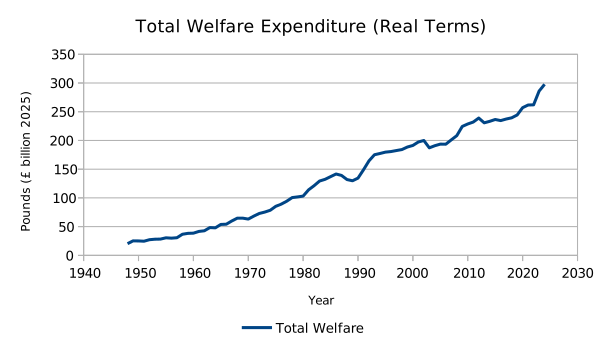
Similarly, it explains why popular yet highly damaging ideologically-driven policies are never removed or fixed. For example: welfare is extremely popular because it’s the government handing out free money to people for nothing in return. This is easily the strongest vote winner as a politician can promise to provide unlimited free cash because it comes from the government rather than his own pocket, meanwhile casting a vote also costs nothing for an individual citizen. The politician receives votes, his career continues and the voters receive free money so they continue voting for him. Any rival politician or candidate must meet or exceed this bribe in order to win, leading to an arm’s race of issuing free money to the populace. Welfare originated from ideology but no politician of any party dares to reduce it, let alone stop it, due to the massive backlash that would arise from the public's addiction to free cash. This is exactly what’s witnessed with welfare expenditure continually rising since its implementation, despite the clear evidence from nearly a century of welfare programmes that simply handing out free cash only temporarily addresses the symptoms of being poor and completely fails to resolve the true causes. The amount of money spent on welfare in 2024 was fifteen times higher than the amount spent in 1948 in real terms,5 yet poor people obviously still exist and everyone repeatedly demands more free money.
Unlimited Money Creation Worsens Everything
To briefly explain how welfare is destructive: the government first creates the money (£298 billion in 2024) and then gives it to qualifying recipients. Those people spend the money on various goods and services they previously couldn’t afford so the prices rise and those people will struggle even more, turning to the government to demand more financial assistance. This creates a feedback loop and continuous inflation of prices, or devaluation of the currency from the other side of the equation. From the government’s perspective, it needs to extort the money back as tax from whomever holds it to counter the inflationary effects it caused, therefore it would have to tax an equal amount of money (£298 billion) from landlords, utility companies, supermarkets, care homes, nurses and so forth.
Such a process quickly becomes extremely messy as these subsequent entities earned money as income through normal trades and operate as profit-making businesses, so taxing them will cause them to compensate for the loss via anything from raising their prices, lowering their quality, decreasing employee wages and so on. The original problem of some people being poor has now spiralled into many problems due to the government’s misguided intervention through handing out free cash. As the government creates and spends more money than it removes through taxes, the result is continuous inflation and devaluation of the currency that everyone uses. Worse still, the government removes money via taxes from unrelated areas such as working people which hinders their ability to self-finance and directly punishes productive work. Government extortion makes those people poorer and subsequently more likely to request financial assistance in the form of welfare from the government; another destructive feedback loop. Ergo, the government’s attempt at trying to help a percentage of the population ends up harming everyone in the country. Banks also cause harm by the same process via the endless creation of money for mortgages and speculative financial products, for instance.
I chose welfare as the clearest example of the government creating money and giving it directly to people, whereas other forms of public spending have additional steps and transformations between the government and the general public, such as the National Health Service. Countries that own their currency and don’t operate with any restrictions on money creation therefore have governments that can create infinite money which is a very dangerous state of affairs and doubly so for political systems that have unaccountable politicians, all of these factors apply to the UK. The government opted-in to restricted money creation until 1971 thus the handbrake on money creation was removed,6 meaning that public spending became unconstrained by tax revenue, as evidenced on the graph below showing government income and expenditure.7
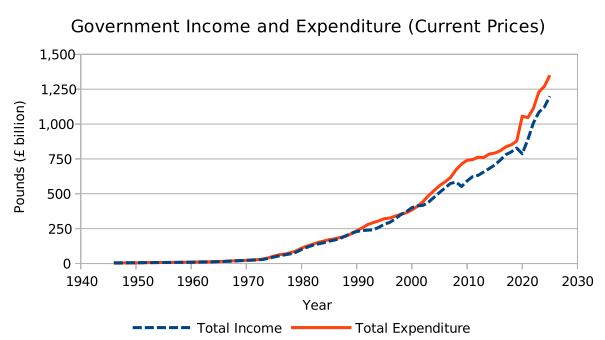
A chancellor can, and will, wreak havoc on the country’s finances due to the complete absence of understanding how money and economies function (the role of chancellor is always obtained by backroom deals, not talent) and his self-interest to do what’s popular in the name of his career will always prevail over what’s genuinely best for the country's economic situation. Combine this ignorance and self-interest with the ability to generate infinite money on demand and it's a recipe for disaster. Sovereign currencies means that taxation doesn’t fund public spending, instead it’s a tool to counter inflation and affect behaviours. Creating free money is popular, while taxing is unpopular and unnecessary to the process; leading to a net excess of money creation and devaluation of the currency, hence why welfare is ultimately destructive and exacerbates the existing problems. This is the same reason why the government’s new Your First Home scheme will make housing more expensive, not more affordable. Politicians and bankers are too stupid and reckless to be trusted with the nation’s money printer.
Any politician that attempts to break this destructive cycle by ceasing the issuance of free money will anger the population that’s grown used to receiving freebies and won’t vote for that politician in the future. Speaking more generally: any politician that would enact genuine fixes to the country’s problems and chooses policies with a long-term perspective will be significantly less popular whereupon he sabotages his own career in the process. The correct choice is often some form of payment or sacrifice now in order to achieve a greater gain in the future, but politics is concerned with popularity in the present moment so it prioritises small instant gains that create large future detriments for someone else to address.
Tapeinocracy recognises these problems, so the genuine solution in this instance would be to stop welfare as it doesn’t achieve anything positive, it fails to address any underlying problems and leads to currency devaluation that makes everyone poorer. If the government wishes to help people then any programme must specifically target the real causes, which will be different for each individual. The constitution would likely ban the provision of cash as a method of assistance, thus people must find more productive means of assistance that don’t cause inflationary effects.
One proposition in the tapeinocracy book describes the construction of community centres that offer access to educational materials, networking opportunities and free classes; helping motivated people to climb out of poverty by learning marketable skills and meeting suitable people. Local residents can teach their skills, enhancing community cohesion and forming a positive feedback loop of passing on knowledge. Unlike continuous cash welfare for a massive percentage of the population, this scheme would only require one-off money creation for the initial construction of community centres and the persistent salaries for a few staff in each building, thus the level of money creation and subsequent inflationary effects would be absolutely minimal; temporary inflation of prices by construction companies during the initial surge of nationwide construction. Additionally, money creation must be strictly limited to prevent its inevitable abuse by politicians and bankers; tapeinocracy disconnects politicians and banks from money creation, while retaining its use for specific situations.
How to Break the Cycle of Endless Failures
The crux of the matter is the relationship between popularity-driven decisions and politicians staying in power for self-interest, alongside the abuse of money creation. If a politician makes choices that are extremely detrimental to the country but very popular with voters then he can sustain his own career indefinitely while the country deteriorates. Even worse, due to the utterly broken voting model and current political system, politicians can perform actions that are both ludicrously damaging to the country and unpopular with voters but remain in power. This is due to the political system only allowing the public to vote for one day every five years thus politicians can freely wreck the country in the 1,825 days between elections as there’s currently no method to remove politicians without violence.
The UK’s political system can be accurately described as an oligarchy elected by theatrical farce that utilises a tragic mixture of autocratic proposals that are voted upon by the oligarchs. Not a single element of this process is positive. The public only has the capacity to elect the oligarchs, then the hobbled autocrat in the form of the prime minister dictates the main legislative proposals for Parliament, finally the oligarchs vote according to self-interest and ideology. Allocation to senior positions is based upon personal reputation and quid pro quos, leading to a situation whereby the oligarchs spend their time backstabbing and climbing over each other, meanwhile the complete lack of any minimum standards for intelligence or integrity means the quality of all politicians is guaranteed to be rock bottom.
Tapeinocracy resolves this despicable system by removing the public’s vote for politicians, thus the emotional speeches, empty promises, lies and media smear campaigns are rendered completely inert. Politicians are elected by sortition (lottery) from a pool of citizens that applied as candidates and passed the tests to ensure they all meet a minimum standard of intelligence, mental clarity, physical health and personal finances. A two-year limit is also imposed on all politicians so they can’t turn it into a career and will be far less appealing to any bribers. The combination of election by lottery, the requirement to exceed minimum standards and an enforced short tenure completely disconnects political decisions from popularity and drastically reduces any opportunities for corruption.
Additionally, in a tapeinocratic society, politicians can’t initiate any policies or political actions; they must originate from citizens and the role of politicians is solely to vote on a citizen’s proposal, further reducing attempts to appeal to the populace. It’s also worth mentioning an important feature that’s suspiciously absent from the status quo: accountability. Politicians are held responsible for their actions, even if they resign or their time in office expires.
This system is designed so that a politician’s choices are motivated by doing what’s best for his community even if it’s unpopular, rather than doing whatever is popular to boost his own career regardless of long-term problems. The role of a politician becomes one of public duty instead of self-enrichment, ideology or virtue-signalling. Citizens hold real power as they must initiate the political process, the constitution filters out bad proposals, then politicians vote on suitable proposals.
A Brighter Future is Within Reach
For as long as this disastrous status quo persists then the country will continue to deteriorate regardless of which political party holds the majority in Parliament or whomever is the prime minister. This is why it’s utterly pointless for the media and electorate to argue about Labour versus Conservative, Green versus Reform, or any other match-up. The system itself must change so that political decisions are wholly disconnected from politicians’ stupidity, self-interest and popularity with voters.
Tapeinocracy resolves this through the following design:
- Political candidates are any citizens that apply and exceed minimum standards
- Politicians are elected by a lottery of candidates, not the public’s votes
- Unelected citizens are the only people that can start political proposals
- A written unalterable constitution filters out egregious proposals
- Politicians vote for or against a citizen’s proposal
- Politicians have a maximum tenure of two years and are accountable for their decisions
If you despair about politics in this country and feel hopeless about the future then a tapeinocratic society would resolve the overwhelming majority of current problems and lead to a brighter future. Buy the book to learn how other areas of everyday life would be vastly improved by tapeinocracy.
References
- Ministry of Housing, Communities and Local Government (2026) New first-time buyer scheme to be confirmed at Budget
- Parliament (2026) Payment of Members (HC Deb 10 August 1911 vol 29 c1483)
- His Majesty’s Stationery Office (2026) Representation of the People (Equal Franchise) Act 1928
- Parliament (2026) Payment of Members (HC Deb 10 August 1911 vol 29 c1391)
- Department for Work and Pensions (2026) Benefit expenditure and caseload tables 2025, autumn budget 2025 (Benefit summary table)
- Office of the Historian (2026) Nixon and the End of the Bretton Woods System, 1971-1973
- Office for National Statistics (2026) Public Sector Finances Time Series (Income: JW2O, Expenditure: KX5Q)
Return to the top of the page.