Tapeinocracy: Government
This page briefly outlines the important elements of government and the political process, including current problems in society and how tapeinocracy fixes them. If you wish to see the step-by-step logical process, data examination and in-depth discussion for how each conclusion is reached then buy the book.
Topics
- Unalterable Principled Constitution as the Supreme Authority
- Sortition Replaces Voting to Elect Politicians
- Local Governments as the Primary Political Power
- Diagram of the Improved Political Process
- Short Time Limit on Political Office
- Limited and Semi-Independent Central Government
- Diagram of Central Government
- Time Limits and Variables in Legislation
Unalterable Principled Constitution as the Supreme Authority
Current Problems
- The fundamental causes of most problems in society result from flaws in human nature and authoritarian ideologies
- Human nature and authoritarianism is a dangerous combination so any government with a central figure or cabal will inevitably be corrupt and incompetent at best or corrupt and malevolent at worst
- People almost never want to give up acquired power without the looming threat of violent reprisal
- Anarchy would be the best societal model from a moral perspective but its biggest weakness is the requirement for every person to be decent and leave the power void intact, alas due to human nature there will always be a percentage of people that seek to fill that void to gain dominion over others
- A problematic individual or group can only effectively be removed by a more powerful group, such as greater numbers or better weapons; the existence of other nation states places smaller entities, such as a potential anarchist society, in a position ripe for invasion
- While anarchy would be the best model from a moral and logical perspective, it doesn’t hold up to reality and fails from a pragmatic perspective so it must be adjusted
- Government is therefore an unfortunate necessity as a faction with the monopoly on violence and must be of sufficient strength to resist external threats and deal with the inevitable percentage of authoritarian types
- The government doesn’t exist as a special entity as it’s still an ordinary group of people so it’s equally susceptible to the same problems with human nature and must be strictly limited in power; anyone assuming that governments are inherently morally good or helpful is woefully naive
- Flaws of human nature create a sad situation whereby a stronger faction is needed to prevent the problematic actions of smaller factions but that stronger faction still consists of people who will exploit that advantage
- Supposed checks and balances built into systems almost always fail to prevent the abuse of power, proportionate to the centralisation of power
Tapeinocracy’s Solutions
- Logic dictates that any system involving authority must have a highest point
- Flaws with human nature means the highest authority can’t be a human or broken derivations of man such as gods and artificial intelligence
- A written unalterable constitution serves as the country’s supreme authority because it provides a carefully manufactured static snapshot of humanity at its best; resulting in a highest authority that’s consistent, doesn’t seek additional power or resources, can’t be bribed, doesn’t have mood swings or narcissism and persists beyond a normal person’s lifespan
- It must be initially created by intelligent, benevolent and anarchic people, thoroughly tested before implementation and then made unalterable to prevent its inevitable corruption by future politicians
- Due to its immutable nature it can’t be too specific or reference anything contemporary like particular technologies or products
- It must be written establishing a default position of maximum freedom with any proclamations written as negatives that restrict the powers of government and any people seeking control over others
- This written constitution can be personified as a passive guardian dictator that only exists to intervene against authoritarianism and problematic human behaviours, in essence it’s the bulwark against the fundamental causes of most problems and provides the steel framework for a better society, while malleable legislation provides the details
Sortition Replaces Voting to Elect Politicians
Current Problems
- Politicians are elected by votes from the public based on popularity thus making the entire process one of populist rhetoric in which politicians gain power solely from their ability to convince, or far more likely lie, to voters
- There are no minimum standards to qualify as a candidate, meaning they can be utterly stupid, openly corrupt and guided by backward ideology
- Flawed voting models such as first-preference plurality (first past the post) have major design issues like vote-splitting thus are guaranteed to create ballots with only two realistic choices, significantly limiting a voter’s options and effect on the political process
- Even the use of a better voting model such as a single transferable vote (STV) still completely fails to address an electoral system built entirely upon popularity; resulting in rampant media manipulation, blatant lies, smear campaigns and ultimately a race to the bottom
- Politicians hold power independently of citizens so once they’re elected the citizens serve no further purpose until the next election; this reveals the true political model of most countries to be oligarchies in which the oligarchs are infrequently elected from a crippled democratic process
- While a simple process exists for citizens to elect politicians there conveniently isn’t any process for citizens to remove politicians, which results in citizens either accepting their powerless position or resorting to darker alternatives
Tapeinocracy’s Solutions
- The use of voting to elect politicians is removed entirely and replaced with a sortition (lottery) of eligible citizens
- Any citizen can apply as a candidate and must pass screening tests for physical, mental, financial and intellectual health so all candidates exceed a minimum threshold of competence
- Whenever new politicians are required the sortition process can be performed almost instantaneously
- This approach has so many advantages over current voting: accurate representation of the population, pre-election bribery is almost impossible, the role of political parties is greatly diminished, removes all nasty election campaigns and media interference, every candidate has an equal chance of election, the election process is extremely quick, it renders all personal connections and financial backing irrelevant
Local Governments as the Primary Political Power
Current Problems
- Central government runs the whole country in the form of the Cabinet and ultimately the prime minister
- Even with a hypothetical truly benevolent and genius leader it’s still practically impossible for one man to run a country as every task must be delegated and the people in subsequent tiers determine the outcomes; leading to a system whereby every prime minister is doomed to inevitable failure
- Problems differ around the country and require individual solutions whereas central government can only provide one-size-fits-all solutions
- Centralised political power makes the country's leadership vulnerable to incompetence, corruption, malevolence and assassination
- Politicians make all of the decisions and citizens are irrelevant except on election day
Tapeinocracy’s Solutions
- The primary element of government and political power moves to decentralised local governments that operate in a specific region, in the UK this would likely be at the county level
- A reduction in the responsible land area and population makes local government far more effective and efficient
- Decentralised power diminishes the destabilising effects of an individual politician’s incompetence, corruption, malevolence or assassination
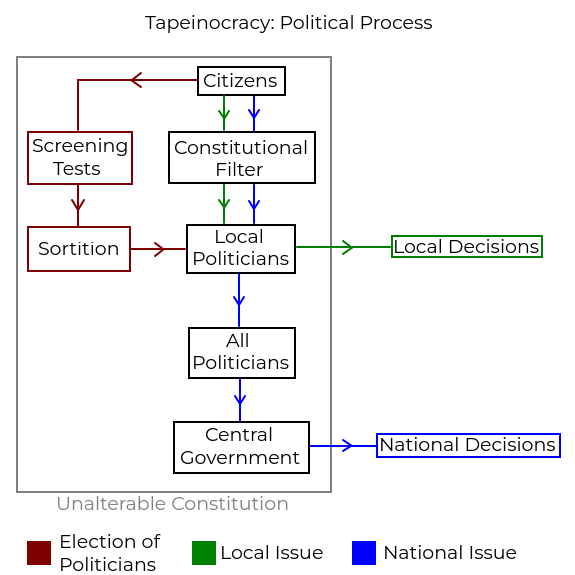
- The political process starts with citizens that can propose any ideas; allowing maximum participation, promoting civic duty and ensuring citizens are always part of politics
- The unalterable constitution acts as a sanity filter to automatically reject any proposals that are idiotic or destructive, leaving only reasonable proposals
- The citizen presents his case to the local politicians who then vote to accept or decline it; they can’t initiate their own proposal or alter a citizen’s proposal
- Local issues are resolved quickly and effectively, simple proposals could be concluded on the same day
- National issues proceed as described, then face a majority individual vote by all politicians across the country
- Power is simultaneously direct and restrained as each group has a specific role in the basic process; citizens initiate proposals, the constitution filters out bad proposals, politicians vote on proposals
Diagram of the Improved Political Process
Short Time Limit on Political Office
Current Problems
- It’s possible for politicians to remain in power for decades due to broken voting models, demographics in constituencies, gerrymandering, corruption and bribery
- If a politician holds a guaranteed position or lacks competition then he doesn’t have to exert any effort in his work
- Any politician known to hold a long-term position will be bribed, especially if politicians are never held accountable
- Holding a position for a long time offers incredible value for money for a briber
- The same politician holding political office for years or decades creates stagnation
- This is exacerbated by the complete lack of any citizen-led process to remove politicians
Tapeinocracy’s Solutions
- All politicians are constitutionally limited to a maximum of two years in office and are banned from future sortitions
- Frequent turnover allows more opportunities for fresh candidates to be chosen and prevents stagnation
- Such a limit still promotes civic duty while limiting opportunities for personal networking or financial gain
- Successful bribes can only buy favours for a maximum of two years
- Bribers must repeatedly approach new politicians and significantly increase the chances of being reported as they lack prior knowledge of a given candidate’s receptiveness to bribery
- Citizens have the ability to request a national majority vote by all politicians, minus the local government in question, in order to remove a specific politician or all politicians of a local government if evidence is provided of corruption or gross incompetence
Limited and Semi-Independent Central Government
Current Problems
- Nation states are the current paradigm in existence across the world therefore a country consisting of anything less, such as the proposed local governments, would inevitably fall apart to that level and lead to invasion by a stronger neighbouring country
- The centralisation of power is a deeply problematic and ineffective form of government
- Politicians routinely interfere with critical state functions
- Human nature means that politicians will always seek to consolidate power
Tapeinocracy’s Solutions
- Central government continues to exist purely on pragmatic grounds as a unifying national entity both within the country and externally to other countries
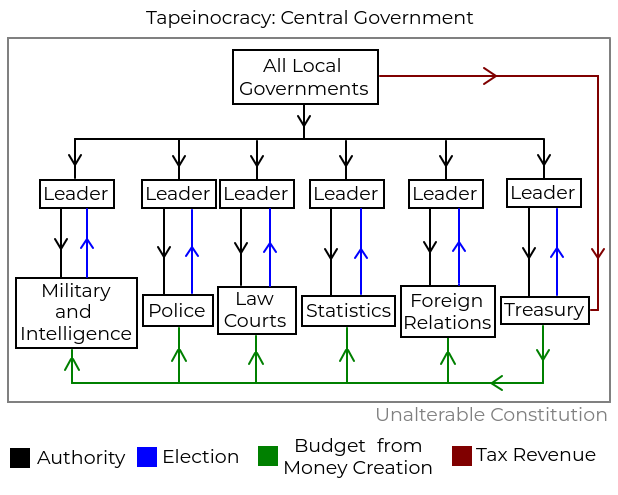
- To prevent centralised power and authoritarianism, central government must be subservient to local governments, including budget allocation
- The constitution severely limits the power and reach of central government
- Central government’s roles can only be those that enable the continuation of the nation state: military and intelligence, police, law courts, foreign relations, treasury and statistics (the statistics department ensures continued data collection for the feedback process)
- Each department has a leader as an accountable intermediary between departments and politicians; departments elect the leader and politicians can vote to remove him at any time
- The existence of a department leader creates authority acting as the carrot and full accountability with potential criminal liability acting as the stick; a leader must exist at all times
- Politicians only set annual objectives and budgets, each department operates independently with its funding and achieving its assigned objectives
Diagram of Central Government
Time Limits and Variables in Legislation
Current Problems
- Legislation lasts forever until it’s hollowed out by future legislation, creating an accumulation of ancient mess that needlessly complicates legal processes
- If a piece of legislation is incredibly poorly written, which is seemingly guaranteed, society must suffer the consequences until sufficient political will exists to fix it
- This would create additional work that politicians don’t want to perform so they kick the can down the road for someone else to pick up
- Solicitors, barristers and judges must navigate a piecemeal statute book, wasting time and resources both in their initial training and in every court case
- Solicitors and barristers can seek different outcomes from the same law or bring a case to a grinding halt by exploiting the current mess of legislation to turn court sessions into endless philosophical meanderings, such as “what truly defines intention?”, while still charging an hourly rate
- Static definitions in legislation means that new legislation is required to update any values in prior legislation, creating more unnecessary busywork
Tapeinocracy’s Solutions
- A piece of legislation only lasts for ten years before it’s automatically removed, preventing the aforementioned build up of ancient nonsense
- If a piece of legislation was of poor quality or created unintended consequences then after a decade it’s guaranteed to disappear, while on the other hand if it’s good quality then it can be repeated with minimum effort
- Should a particular law leave a glaring hole in the legal system upon its removal then it forces politicians to vote on a suitable replacement because they’re held accountable for the consequences
- Even if many politicians want to lazily repeat every piece of existing legislation, the political process begins with citizens thus providing opportunities for citizens to propose suitable replacements (citizens will include frustrated policemen, judges, barristers et cetera)
- Legislation includes variable definitions with original values and a preset range of minimum and maximum values; the law applies nationally while local governments can set their own values allowing regional flexibility and avoiding further legislation
Return to the top of the page.