
Tapeinocracy: Economics
This page summarises the main changes that would occur with taxation, public spending, banking, business and the economy at large. Again, for the sake of brevity this page summarises the proposals so if you wish to read through all of the logical processes and data to reach these conclusions then buy the book.
Topics
- Replace Destructive Taxes with a Land Value Tax
- Resolve Negative Actions with New Variable Behavioural Taxes
- Diagram of the Proposed Monopoly Tax
- Diagram of the Tax and Public Spending Model
- Stop Government Abuse of Money Creation and Borrowing
- Remove Non-Government Money Creation
- Diagram of Improved Private Banking
- Merge the Bank of England into the Treasury
- Replace the Country’s Disastrous Ideological Economic Models
Replace Destructive Taxes with a Land Value Tax
Current Problems
- Every current form of tax is destructive and leads to absurd outcomes
- Income tax directly punishes work, while progressive bands further punish higher wages and a 0% initial band rewards low wages
- Value Added Tax (VAT) punishes consumption, the flat rate disproportionately affects poorer people and VAT was only created as a prerequisite to join the European Union so it’s no longer necessary
- National Insurance is a second income tax that especially punishes employers for hiring staff and makes them reluctant to do so
- Corporation tax punishes companies for being profitable
- Council tax punishes property ownership with an utterly bizarre rating system based on imaginary 1991 values
- Business rates punish the use of commercial property by charging an arbitrary amount per square metre
- Capital gains tax and inheritance tax are petty ideological taxes against wealth
- Taxes on petroleum, tobacco, alcohol, gambling and sugar fail to address the relevant underlying problems
- The combined absurd outcomes of these taxes creates a society in which higher wages, increased productivity, profit, wealth and spending are all punished so the whole economy and population is permanently crippled
- If productive work is harshly punished by the government then people will use alternatives such as rent-seeking, creative accounting or living entirely on welfare
Tapeinocracy’s Solutions
- Taxation is extortion of citizens by the government yet a minimum level of taxation is required for the continuation of the nation state, making some level of taxation necessary and immoral
- The inherently immoral nature of taxation means it must be limited in magnitude and kept that way by the constitution as politicians will inevitably expand taxes with the offer of additional public services
- Any form of tax must therefore be justified as a least worst option and avoid creating absurd outcomes, immediately ruling out all of the current tax methods
- Replace all current taxes with Henry George’s land value tax on the value of unimproved land as the primary source of tax revenue, justified as the fairest tax method and it doesn’t create any absurd outcomes
- A national 10% land value tax is estimated to generate £600 billion per year, more than enough to cover core government functions and reasonable public spending
- Land value tax punishes land speculation and rent-seeking, while encouraging property construction, productive land use and it’s simple to administer with no evasion; if a landholder for a given plot is obscured or unable to be contacted then the land automatically transfers to public ownership
- The majority of people would pay lower tax than the current system: for example someone holding land for a typical terraced house in Bolsover would pay £555 in tax per year, whereas at present that person earning minimum wage in 2026 working full-time pays approximately £3,500 as income tax and National Insurance, let alone VAT, council tax and the rest
- The people paying more tax would be those living in high value areas such as Belgravia and Westminster in London at the top end with a land value tax of about £200,000 per year; while this figure is high it’s because London is currently overvalued and land is used inefficiently, plus the lack of other taxes means wealthy people would no longer be punished for high incomes
- Over time, LVT will make people invest and live in other areas of the country, while London will have to build upwards rather than outwards
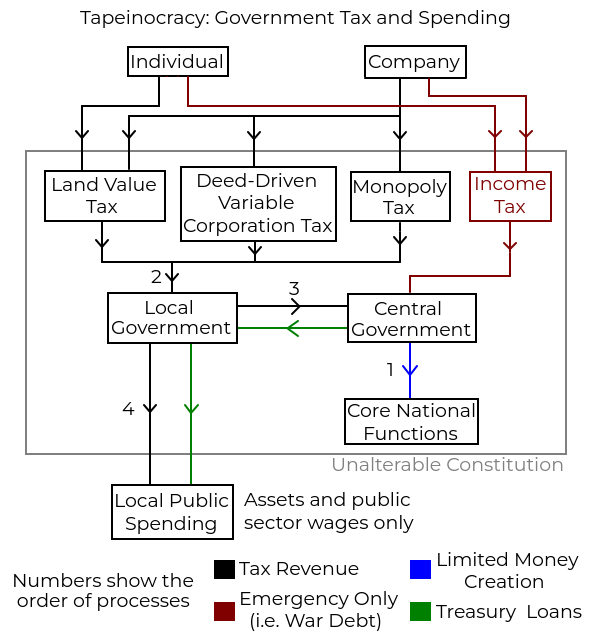
- Income tax is kept but disabled by default and is only used in emergencies such as war to repay excess money creation by the central government, it would be a flat rate for everyone and paid directly to central government to avoid exploitation by local governments; the constitution places a strict ten year limit for repayment to ensure the costs from any wars or natural disasters aren’t passed to future generations and then income tax is disabled again
Resolve Negative Actions with New Variable Behavioural Taxes
Current Problems
- Businesses initially grow through positive means such as innovation, competitive prices and productivity; once a company reaches a financial plateau then it will seek further profits by decreasing its costs via negative activities such as reducing the quality of its goods and services, exploiting its staff or bribing the government to obtain a monopoly
- Governments respond through broken methods such as increasing taxes on outputs, increasing legal minimum wages, creating endless government regulators, bureaucratic licensing or byzantine laws; all of which create more problems than they solve
- None of the existing approaches actually deals with the underlying problems and they negatively impact every company rather than only the problematic companies
Tapeinocracy's Solutions
- Two new variable behavioural taxes apply on a per-company basis and are entirely under the control of each company via its actions: an altered corporation tax and a monopoly tax
- The deed-driven variable corporation tax starts at a low default rate (likely 10%) so it’s already more competitive than most countries, then the tax rate varies depending on reported proven activities: good deeds lower the tax rate and bad deeds raise the tax rate
- Examples of good deeds include: reinvesting profits into equipment upgrades, fair employee wages, providing continuous training and charity in the local community; these could lower the company’s tax rate down to 0%
- Examples of bad deeds include: polluting the environment, mistreating staff, giving all profits to external shareholders, providing low quality goods and services; these could increase the company’s tax rate up to 100% if negative actions persist
- Companies will want to submit positive reports due to self-interest while whistle-blowers, competitors and the public will be the ones to submit negative reports; creating a self-regulating system and real claimants must provide all of the evidence, plus false claims result in an automatic criminal conviction
- This tax method turns natural greed into a positive force with minimal government involvement and it empowers everyone from the company itself to its employees and the public; trade unions, strikes and bribes all become irrelevant
- The new market share monopoly tax is an exponential tax on a company’s revenue based on its rolling average percentage share of a given market category; all companies are legally required to choose a market category that accurately reflects its business
- This monopoly tax starts at 0% and uses a minimum threshold so it only applies to large companies with significant market presence and revenue
- As a result, this simple exponential tax on rolling average market share leaves the vast majority of companies unaffected, while it punishes the practice of mergers and acquisitions or companies seeking total market dominance, steering companies towards continuous innovation through ever-present competition
- The combination of these behavioural taxes means that companies can generate greater profits through constructive business practices than at present, while any companies that choose destructive practices will cause their own ruination
- The strengths of the free market are maintained while its main flaws are resolved through simple, effective and direct solutions
Diagram of the Proposed Monopoly Tax
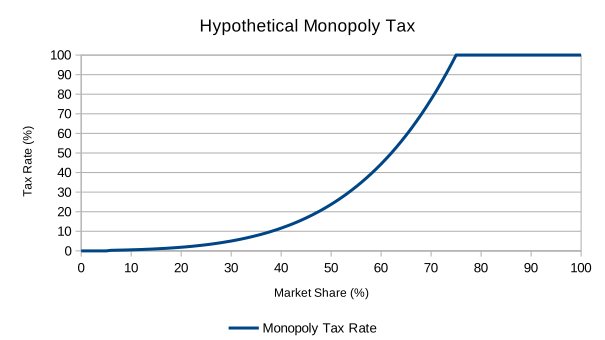
In this example, the minimum threshold is 5% market share so the tax rate is 0% up to that point. At 20% market share the tax rate is 1.8%, 40% market share is 11.6% tax, 60% market share is 44.4% tax.
Diagram of the Tax and Public Spending Model
Stop Government Abuse of Money Creation and Borrowing
Current Problems
- The UK government uses pound sterling as a sovereign currency which enables it to create money on a whim; this is an incredibly powerful tool that must be used responsibly but the government abuses it because the process is completely unrestrained
- In order to minimise inflation and maintain stable prices, the amount of created money must be balanced by removing an equal amount of money in the form of taxation
- The government’s abuse of this system arises due to money creation happening first so politicians gain popularity for providing free public services and cash, then the unpopular aspect of removing money via taxation happens afterwards; thus politicians only want to perform the first half of the process to maximise their popularity which constitutes a considerable moral hazard as resulting currency inflation
- This excess money isn’t automatically inflationary by its creation but is likely to be inflationary wherever it’s spent; such as cash payments via welfare, which is then spent on food, utilities, rent et cetera
- The government also sells bonds to the private sector at an amount matching its deficit: this is a confused historical relic that no longer applies and actually means the government chooses to act as a savings account due to ignorance
- Investors exploit government bonds for their safety because a government with a sovereign currency will never go bankrupt thus bonds are prioritised over other forms of investment, more so when the economy is poor as bonds will have a better return on investment
- An absurd outcome is created as interest payments on government debt are a de facto form of welfare for the rich
Tapeinocracy’s Solutions
- Politicians can’t be trusted with money creation, especially in political systems such as the status quo where it’s directly connected to their popularity, so both must be permanently disconnected and any interactions strictly limited
- Money creation as a tool is kept by the Treasury in central government and it can only be used to cover its necessary core national functions, then the money must be balanced by tax revenue from local governments to minimise inflation from excess spending and create another protection from bureaucratic expansion
- Politicians are contained within local governments that must operate akin to personal finances whereby they generate tax revenue from citizens first and can only spend existing money; ensuring politicians never create money or overspend
- Tax revenue primarily exists as a land value tax that’s stable and consistent therefore if politicians want more tax revenue they first have to increase local land value by investing either public money into infrastructure upgrades and public amenities, or encouraging private investment in developments; both will lead to positive outcomes for society
- Government borrowing is completely unnecessary to the public financial process so it’s disabled by default
- If a local government wants to spend beyond its tax revenue, it can propose a costed project for productive assets to a national vote, which if it passes a majority vote then the Treasury issues a loan of matching value to the local government
- The constitution sets a maximum time limit for each government loan that must be repaid to the Treasury to rebalance the money supply; politicians are held accountable
Remove Non-Government Money Creation
Current Problems
- Private banks have legal permission from the government to counterfeit money and they abuse it by creating endless money for unproductive means such as mortgages and financial products; this extreme money creation is responsible for 80% of the money supply and leads to massive inflation wherever it’s spent, such as vastly overpriced housing due to oversupplied mortgages
- In the UK, there’s no legal limit on money creation by banks as only two minor inconveniences exist: one, a minimum capital ratio that can be bypassed; two, the ability to settle daily inter-bank payments at the central bank that can also be circumvented by banks lending to each other
- The only practical limit on money creation is the demand by borrowers
- Banks are highly motivated to create as much money as possible in the form of loans with interest as the method of generating profit, meaning they only care about creating maximum debt and don’t care where that money is spent; this is a moral hazard
- Central bank reserves act as inter-bank settlement which can be completely ignored by coordinated transactions, in turn leading to an inevitable cartel of a few major banks which is exactly how the UK banking system operates
Tapeinocracy’s Solutions
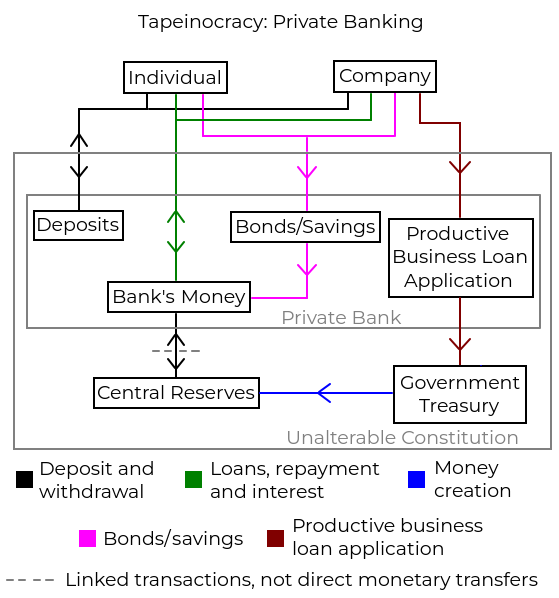
- Banks lose the legal permission to freely create money, instead each bank must operate an internal account that’s corroborated by the reserves with the Treasury; if a bank creates £10,000 for its internal account then the Treasury removes £10,000 from the reserve account and vice versa
- This creates a simulated deposit and withdrawal system between private banks and the Treasury but no actual transfer takes place; it’s just corresponding additions or subtractions so money in banks and central reserves is still strictly segregated
- Customer deposits act purely as storage of money for safety and convenience, banks can’t use this money for any transactions
- Customers may buy bank bonds as a form of saving with interest, banks can use this money freely and the customer can’t reclaim the money prior to the bond’s maturity
- Both of these specific design choices will make bank runs almost impossible
- Customers seeking loans for productive business purposes (criteria set by national government vote) allow banks to apply to the Treasury for money creation; if successful, the Treasury creates money and credits the private bank’s reserve account with the loan amount
- As a result, all bank transactions must use a fixed supply of money, while productive business loans are the only method of money creation for the private sector; banks are more scrupulous about general lending while lending for productive business is strongly encouraged and made easier thus leading to higher wages and the property bubble finally deflates leading to cheaper housing
- If banks want more money they have to promote investment by customers via bonds with competitive interest rates and/or focus more on productive business
- Any staff that fraudulently manipulate accounts are directly punished by forfeiture of their personal assets, their citizenship and are physically removed from the country; any banks that spectacularly fail from over-leveraged loans will have their senior staff executed by any volunteers from aggrieved customers or shareholders
- While this section mentions private banks, these rules apply to every financial organisation including the shadow banking sector
Diagram of Improved Private Banking
Merge the Bank of England into the Treasury
Current Problems
- The Bank of England is a historical relic that was created in 1694 as a private bank for investors to lend to the government at a higher rate of interest than other banks, with interest payments from the government guaranteed by introducing new taxes on the population; turning the traditional borrower-lender relationship into a three way relationship with the introduction of the taxpayer
- It was specifically created to allow the continued funding of war through credit instead of existing taxation and led to the creation of the national debt; this is a moral hazard as it moves government funding and financial responsibility from the present to the future
- In the present day, the BOE is now a central bank that occupies a strange position as a de facto parallel private bank with monopoly powers granted by the government; this is also a moral hazard as it’s unaccountable and free to make its own choices while enjoying the privileges of authority from government
- Examples of questionable behaviour include abusing the law to secretly purchase stocks in listed companies on behalf of heads of state, their family members, governments and any well-connected individuals around the world
- It claims to control the economy and inflation by adjusting its interest rate inverse to economic activity, despite this mechanism having never been proven and the data shows it’s completely wrong
- Similarly, the large-scale asset purchases of government bonds since 2008 was undertaken with a flawed belief and complete misunderstanding of how the financial system operates, so it achieved nothing useful
- The government and BOE often pull in opposite directions; on a practical level it’s extremely unhelpful and it signals gross incompetence to everyone else
- The BOE serves no genuine purpose other than a networking club for bankers and government officials with its meetings and finances kept secret
Tapeinocracy’s Solutions
- Dissolve the BOE and move the important functions into the Treasury: creating cash, settling inter-bank payments and operating the central reserve as a tool to affect the behaviour of private banks
- Folding these important functions into the government reintroduces accountability and prevents the abuse of the BOE’s unique position as a half private, half public bank serving its own interests
Replace the Country’s Disastrous Ideological Economic Models
Current Problems
- Since 1945, the UK operated three distinct ideologically-driven economic models that are utterly broken and have decimated the country
- Firstly, Clement Attlee’s socialist model of central planning, the government choosing where companies can perform business, nationalisation of industries, high taxes, high public spending, control of industries by trade unions; the country turned from the workshop of the world into an uncompetitive international laughing stock
- Secondly, Margaret Thatcher’s inconsistent policies that deregulated the financial sector and placed a heavy focus on banking as the country’s primary industry, privatised some public assets far below market value while maintaining other public assets such as British Rail; Right to Buy exacerbated long-term housing supply and the reliance on banking only created intangible wealth on spreadsheets rather than useful goods and services
- Thirdly, Tony Blair’s model of globalisation via mass immigration with a justification that increasing the total number of workers (rather than increasing productivity) would generate more tax revenue to balance massively increased public spending; all it achieved was downward pressure on wages, promoted low value jobs and increased demand on public services and housing
- The common theme of these broken models is their ideological foundation and politicians’ stubborn refusal to adapt when proven wrong; leaving remnants of each that persist to the present day
- Britain still uses central planning, an oppressive planning permission system, no wealth funds, low quality public assets, unrestrained money creation, a tsunami of un-integrated immigrants exceeding infrastructure capacity, eye-watering welfare spending and a low productivity economy
- Since the 2008 global financial crisis, politicians have abandoned the economy entirely and left all infrastructure to decay (for example, total electricity supply is currently half of what it was in 2000) while placating the population with higher welfare, higher minimum wages, mortgage subsidies and continued mass immigration to plug employment gaps
Tapeinocracy’s Solutions
- Don’t build an economy on ideology, build an economy on effectiveness and ensure it’s flexible
- Productive companies offering useful high-quality goods and services in an unfettered environment of free trade is most likely the best way to run an economy and improved personal productivity offers a proven ladder out of poverty
- Block all low-value legal immigration (manual labour) and all illegal immigration; high-value legal immigration (scientists, engineers) is fine and should be made easier
- Blocking all low-value immigration reduces downward pressure on wages and demands on limited resources, such as housing or public services; high-value legal immigrants will be exceedingly fewer in number thus more manageable and beneficial to society
- Introduce a legal requirement for a domestically registered company in order to conduct business in the country, minimising international legal disputes and options for exploiting the system
- The behavioural tools of the deed-driven variable corporation tax and the market share monopoly tax provides an effective carrot and stick to encourage positive actions by companies while punishing negative actions and ought to efficiently resolve the issues of excessive greed currently observed in most countries
- Low to potentially zero corporation tax and zero income tax will turn the country into a beacon for competitive business alongside easing the cost of living for everyone
- The effects of the land value tax and the inability for banks to create money for mortgages will significantly decrease property prices
- Only permitting money creation for productive business loans will steer banks towards useful business and away from unproductive assets
- All of this creates a healthy business environment whereby companies are free to flourish or fail, they self-regulate or regulate each other and the government’s role is only to provide boundaries against destructive behaviours
- Upgrade infrastructure nationwide to enable productive business: nuclear power is currently the only source of stable scalable carbon-neutral electricity, build it on a large scale to support a revitalised economy; bring transport into the 21st century
Return to the top of the page.